Mrs Emma Hill
Our SENDCo (Special Educational Needs and/or Disabilities Coordinator.)
You can contact them through the main school office or via:
contactus@liftutterby.org.Our vision for children and young people with special educational needs and disability (SEND) is the same as for all children. We strive to ensure access for all to educational excellence in preparing children and young people for their futures, seeking to continually improve attainment and progress for all and secure the highest levels of achievement appropriate to the individual learner.
Your child’s time at our school is a partnership between us, the pupil and the family and we aim to build on the foundations that you, as parents or carers, have put in place at home. Ultimately, we all want the best for the children and this aim underpins every decision made at our school, including for those with a special educational need or disability (SEND)
For more details of the Lincolnshire County Council Local SEND Offer please click the link: Lincolnshire County Council Local Offer
At Lift Utterby we are an inclusive school and do all we can to ensure that children with any disabilities or barriers to learning can participate in everyday school life. Through a broad and balanced curriculum, classroom organisation and highly dedicated staff we endeavour to provide equal opportunities for every one of our learners.
- Communication and Interaction
- Cognition and Learning
- Social, Mental and Emotional Health
- Sensory and/or Physical Needs
The Government provides some advice for parents and carers about Special Educational Needs and Disabilities which you can access here https://www.gov.uk/children-with-special-educational-needs
View our SEND policies here
We are committed to ensuring that pupils with medical conditions are fully supported in school so that they can:
- Play a full and active role in school life;
- Access and enjoy the same opportunities at school as any other child, including school trips and physical education;
- Remain healthy and safe;
- Achieve their academic potential.
If a student has a medical need, they will have a Care Plan, which is compiled in consultation with parents and one of our medical assistants. The plan is discussed with all staff who are involved with the student and is added to the student’s profile, so staff can access it.
Staff receive regular medical training delivered by the school medical assistant and are aware of where they can access further information as required.
Where necessary and in agreement with parents, medicines are administered in school but only with signed parental consent and with medicines in the original packaging.
We welcome students with special educational needs or disabilities and support students across four teams. Students are organised into the teams during their transition from their previous school and it is based on the student’s main area of need. An Area of Need leader will monitor their academic progress and attendance whilst ensuring that the student’s needs were been met both through teaching and structured interventions.
Cognition and learning support
For students with specific learning difficulties such as dyslexia, or moderate learning difficulties that affect students in a range of cognitive areas.
Social, emotional and mental health support
For students who struggle to engage in the social aspects of school, or who find it hard to cope with challenging emotions. This will range from students needing short-term assistance during a turbulent time in their life, to students with a recognised condition such as ADD or ADHD.
Communication and interaction support
For students who have speech, language and communication needs, a specific language impairment or a range of communication difficulties. Students who find it difficult to interact with others are supported within this area.
Sensory and physical support
Students whose need is primarily sensory and, or physical have their support overseen by the area of need leader in this team. This team would support students with hearing or visual impairments as well as students with physical needs.
What is a Special Educational Need?
A child has a special educational need if they have a learning difficulty or disability which requires special educational provision to be made for them. A child of compulsory school age or or a young person has a learning difficulty or disability if they:
- Have a significantly greater difficulty in learning than the majority of others of the same age
- Have a disability which prevents or hinders them from making use of educational facilities of a kind generally provided for others of the same age in mainstream schools or mainstream post 16 establishments.
A child under compulsory school age has special educational needs if they fall within the definitions above or would do so if special educational provision was not made for them. (Clause 20, Children and Families Act 2014)
What is a disability?
According to the Disability Act (2010) a person has a disability if:
‘They have a physical or mental impairment, and the impairment has a substantial and long-term adverse affect on their ability to carry out normal day-to-day activities.
Identifying Children with Special Educational Needs
All children at the school are regularly assessed within the classroom and, more formally, on a termly basis. If any concerns are raised by the class teacher then an initial concern form will be completed and handed to the Special Educational Needs Co-ordinator (SENCo) who will then deal with it appropriately. Sometimes it is the parent who raises the concern and, if this is the case, then we will work closely with the family and child to understand and address the issues.
What happens before we make a decision?
The teacher and SENCo will take into account:
- Teacher assessment and knowledge of the child
- Pupil progress and attainment
- Pupil behaviour
- Pupil views
- External Advice
- Discussion with SENCO, class teacher, parents and child
In the first instance we would invite you to make an appointment with your child’s class teacher. It may be appropriate to ask the SENCo to attend the meeting. If your child does have a special educational need, which requires teaching and support above and beyond what is already provided in the classroom then they will be placed on SEN Support Register.
If a child is put on SEN support they will be closely monitored according to the SEN code of practice. You will be kept informed of the additional support your child is receiving.
Arrangements for Consulting the Child
At all times we will do our best to keep the child involved in the process. However, there will be times when this is difficult for example, due to the young age of the child. As the children in our school are aged 4 - 11 parents will be asked to attend all meetings along with them.
How We Keep Parents Informed?
Your child’s education is a partnership between parents and teachers and regular communication is encouraged between school and home.
- Parents Evenings are held twice a year and parents are invited to make appointments to see their child’s teacher. If a parent has any concerns at any other point throughout the year then we actively encourage them to make an appointment to see their child’s teacher.
- Specially arranged review meetings with parents, class teacher and the SENCo take place to discuss their child’s progress and set targets for their child to work towards.
- Annual Reviews, for children with Education Health Care Plans (EHCP).
- TAC (Team Around the Child) or EHA (Early Help Assessment) meetings.
- You will be informed by letter of any outside agency involvement and asked to give your permission for your child to work with them. We will also work with you to ensure you completely understand what is happening and who your child is working with. Once the report is received, you will be invited into school to discuss the report and talk about any concerns you may have.
What Can I Expect the School to do in Order to Meet My Child’s Special Needs?
- Quality First Teaching is the teaching your child receives in the classroom on a daily basis. We strive to ensure that this is good or outstanding at all times. All lessons are carefully differentiated to ensure that all pupils have access to a broad and balanced curriculum.
- The class teacher may decide that it is in the best interest of the child to access extra support through small group work with a teaching assistant helping.
- With your permission and where appropriate, the school may decide to involve STAPS (Specialist Teaching and Applied Psychology Service) to gain further advice and support for your child.
- Sometimes the school may feel that it is appropriate for other outside agencies to help support your child, this could be Speech and Language Therapist, Physiotherapist or Occupational Therapist. No agencies will be involved without your permission, unless there is a safeguarding concern.
- The school may decide to continue to use an IEP (Individual Education Plan) to monitor and keep track of your child’s progress. This will have individual targets on for your child to work towards.
- If we feel that your child needs more specialist support than can be offered within the class teaching of the school then we may decide to ask the local authority to undertake a statutory assessment of your child’s needs. The school will gather together all of your child’s assessments, additional strategies used and interventions and, with your permission, send it to the local authority for them to consider whether to carry out a statutory assessment. Throughout this process the school will continue to support your child’s needs.
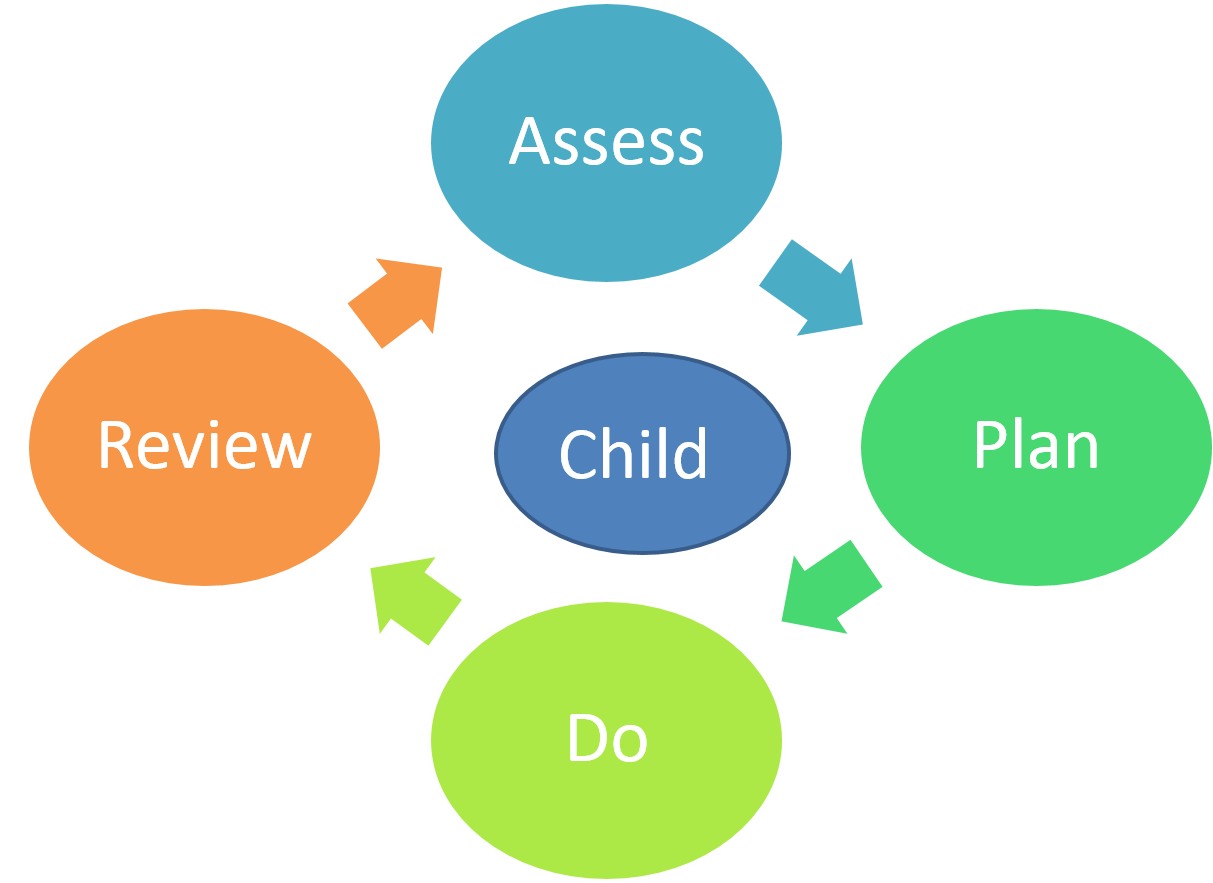
Assess
We will gather information about your child’s well-being, previous progress, motivation, attainment and learning from everyone involved with your child so that we gain an accurate picture of your child’s needs. This usually involves the child, teacher, SENCo, parents/carers and any outside agencies which are involved.
Plan
A support plan (IEP) may be written for your child to outline what will be put in place in order for them to achieve specific targets or outcomes.
The plan may include:
· Quality first teaching strategies that are effective to enhance learning.
· Any focussed support from a teaching assistant or teacher.
· Intervention that will be used to achieve specific targets and how they will be delivered.
· Resources to support access to the curriculum.
· Suggestions about how the parent can contribute to the plan
Do
The IEP is a working document to be used by all those supporting the child, however, the class teacher remains responsible for the child’s progress and will work closely with any other adults involved to plan, assess and review the document. Any adjustments to the plan will be made accordingly after discussion between the class teacher and SENCo and parents will be kept informed.
Review
The IEP will be reviewed at least termly. The impact of support will be measured as well as progress towards their targets. Both parents and pupils will be asked for their views as to what has worked well and what they feel needs to change in order to support the child’s next steps of learning. Once a decision has been agreed about any changes the IEP will be updated to allow the child to work towards their ‘next steps’. If more information is needed, advice or support from outside agencies may be requested.